Myth of America's "Mightiness" Broken in Korean War
Pyongyang, July 27 (KCNA) -- The Korean War (June 1950-July 1953) was a disgraceful war for the U.S. imperialists because it exploded the myth of their "mightiness" and started them on the downhill.
At that time many people of the world were thinking that there was no power to match with the United States on the globe and that a country could achieve democracy, freedom and sovereignty only with its "assistance". (continued)
Korean Victory Day Observed
Pyongyang, July 27 (KCNA) -- Shapril Arsiyad, chairman of the Indonesian Federation of Transport Workers Unions, released a statement on July 21 on the occasion of the 57th anniversary of the Korean people's victory in the Fatherland Liberation War.
July 27 was a day when the Korean people emerged victors by shattering the myth about the "mightiness" of the U.S. in the war, the statement noted, and went on:
The DPRK won a shining victory in the last Korean War thanks to the outstanding strategy and Juche-based war methods of President Kim Il Sung and the Korean people's heroic self-sacrificing spirit. (continued)
Wednesday, July 28, 2010

Tuesday, July 27, 2010
Old News
 Japan to the Great Bear, Chicago Tribune, January 6, 1904
New York Times December 23, 1987 - RUSSIA ABSORBING KOREA; Her Agents Control the Country, and Japan Is Getting Ready for Impending Hostilities. BRITAIN IN A WAITING GAME She Would Welcome Some Action by the United States -- German Press on the "Splendid Isolation of England."
SEATTLE -- The Russian Bear has laid a heavy arm on the fighting material and the army of little Korea. Not content with practically seizing the finance and customs systems of the country, M. Despeyer, the new representative of the "Land of Everlasting Turmoil," has caused the appointment of Russian subjects to the command of the army, and Russians are now in charge of the arsenal. Such is the import of Oriental advices received here to Dec. 6 by the imperial steamship Kamakura Maru, which arrived yesterday from Yokohama.
It appears that the news by cable has not given full particulars of the situation in Korea. The Seoul correspondent of The North China News says:
"We are on the eve of important changes in Korea that will not only affect the Korean nation, but will change the whole aspect of affairs in the far East. Unless one of the treaty powers interferes, Korea will speedily become Russian territory.
+/-
Sunday, July 25, 2010
Saturday, July 24, 2010
LA Times Attempts to Cast Doubt on Sinking of Cheonan

The South Korean Navy's Rear Adm. Park Jung-soo conducts a media briefing in front of the wreckage of the naval vessel Cheonan.
An article published in this morning's Los Angeles Times calls doubt onto the sinking of the Cheonan in March. The article sites individuals such as the South Korean investigative journalist Shin Sang-Chul, South Korean born U.S. academics, a former Defense Ministry official, and a military oversight body. The investigative panel on the Cheonan incident has not released its detailed findings to the public; however, U.S. officials remain convinced that its conclusions are valid.
+/-
Opponents of the official story argue that there was no sign of a torpedo impact on the boat and that the fragments of the torpedo, which implicated the North Korean's, were fabricated. They believe instead, that the boat hit a coral reef and tore itself apart. As can be seen from the above photo however, the ship essentially split in half. While traditional depiction of torpedoes assumes that they puncture a ships hull and cause internal damage, flooding the ship, scientists say that a more effective use is to detonate the torpedo in the water, near the hull of the ship.
Geoffrey Forden, who has a PhD in physics and is a researcher at MIT, gives a great explanation of exactly how this phenomena occurs, contrasting it to the attack on the USS Cole, which was in fact a direct torpedo hit. Essentially the blast of the torpedo carries significantly more power in water than in air (or the inside of a ship), as do other waves e.g. sound. When it detonates it creates a massive pillar of water which has the power to split a ship in half. He has some great pictures of this effect.
There is no doubt that all information about this incident has not been made fully public; however, it is perfectly likely that the reasons for that are security and diplomacy related, rather than an attempt to conceal fraud.
Morning News Roundup
The story dominating the news this morning is North Korea's new response to the joint military exercises planned to begin Sunday. They have declared that "the army and people of the DPRK will start a retaliatory sacred war of their own style based on nuclear deterrent any time necessary in order to counter the U.S. imperialists and the South Korean puppet forces deliberately pushing the situation to the brink of a war." Is this the North Korean version of Jihad? Perhaps.
North Korea Declares "Sacred War" on U.S. and South (Reuters)
U.S. Aircraft Carrier Ups Pressure on NKorea (AP)
North Korea Declares "Sacred War" on U.S. and South (Reuters)
U.S. Aircraft Carrier Ups Pressure on NKorea (AP)
Friday, July 23, 2010
Morning News Roundup
In the news today, more blustering from both sides, this is still a rhetoric game, but we'll see if it stays one.
N.Korea leader Kim sends choppers for flood victims (Reuters)
Video: North Korea protests joint drill (Washington Post)
North Korea threatens "physical response" to U.S. moves (Reuters)
UN Command confronts NKorea over ship sinking (Washington Post)
North Korean eyes open as Hillary Clinton passes by (BBC)
N.Korea leader Kim sends choppers for flood victims (Reuters)
Video: North Korea protests joint drill (Washington Post)
North Korea threatens "physical response" to U.S. moves (Reuters)
UN Command confronts NKorea over ship sinking (Washington Post)
North Korean eyes open as Hillary Clinton passes by (BBC)
Wednesday, July 21, 2010
Most Menacing Compass Ever
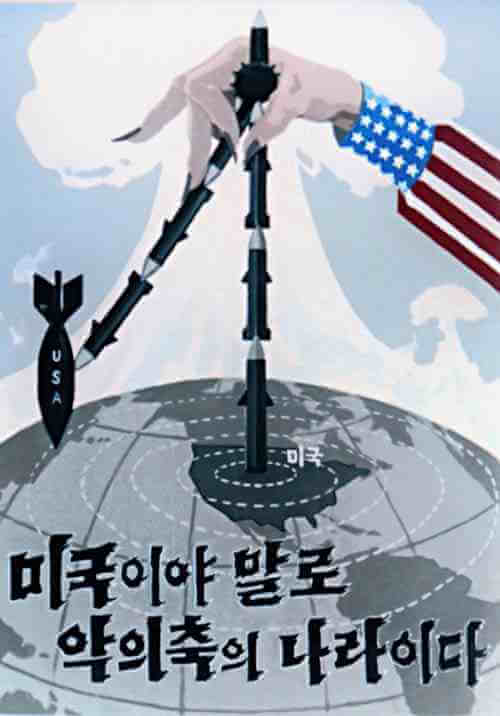 The United States is truly the Axis of Evil
A wonderful collection of North Korean propaganda posters by David Heather and Koen de Ceuster is available through the California Literary Review
You can also purchase the book North Korean Posters: The David Heather Collection on Amazon.
You can also purchase the book North Korean Posters: The David Heather Collection on Amazon.
Morning News Roundup
The top story today has been the announcement of increased sanctions against North Korea. As Secretary of State Hillary Clinton is in South Korea for a diplomatic visit, we should expect a lot of statements to come out of the U.S. in the next couple days.
US announces new sanctions against North Korea (BBC)
Ex-spy from N. Korea visits Japan, renewing inquiry into 17 abductees (Washington Post)
NKorea on damage control at Asia security meeting (AP)
U.S. Spy Chief Nominee Clapper Sees Rising Danger in North Korea Relations (Bloomberg)
FACTBOX- International Sanctions Currently in Force Against North Korea (Reuters)
US announces new sanctions against North Korea (BBC)
Ex-spy from N. Korea visits Japan, renewing inquiry into 17 abductees (Washington Post)
NKorea on damage control at Asia security meeting (AP)
U.S. Spy Chief Nominee Clapper Sees Rising Danger in North Korea Relations (Bloomberg)
FACTBOX- International Sanctions Currently in Force Against North Korea (Reuters)
Dispatch from the KCNA
First a lighthearted bit about yogurt, why one would think it a great idea to make yogurt from potatoes when making yogurt the regular way has been pretty much perfected is just the kind of question you should never ask the North Koreans.
Potato Yogurt Made for Children
Pyongyang, July 20 (KCNA) -- "Potato yogurt has been produced in the Democratic People's Republic of Korea for the improvement of children's health...The institute made it by fermenting lactic bacteria after removing solanine from potato and turning high molecular substances into low molecular ones." (continued)
The next story is a good example of why it can be helpful to read the KCNA for more than simply amusement.
Projected S. Korea-US Joint Saber-rattling Assailed
Pyongyang, July 20 (KCNA) -- "The joint military exercises to be staged by the group of traitors together with its U.S. master despite strong public protest and denunciation at home and abroad are a very dangerous saber-rattling aimed at further straining the already deadlocked inter-Korean relations and igniting a nuclear war against the DPRK, while watching for a chance." (continued)
Potato Yogurt Made for Children
Pyongyang, July 20 (KCNA) -- "Potato yogurt has been produced in the Democratic People's Republic of Korea for the improvement of children's health...The institute made it by fermenting lactic bacteria after removing solanine from potato and turning high molecular substances into low molecular ones." (continued)
The next story is a good example of why it can be helpful to read the KCNA for more than simply amusement.
Projected S. Korea-US Joint Saber-rattling Assailed
Pyongyang, July 20 (KCNA) -- "The joint military exercises to be staged by the group of traitors together with its U.S. master despite strong public protest and denunciation at home and abroad are a very dangerous saber-rattling aimed at further straining the already deadlocked inter-Korean relations and igniting a nuclear war against the DPRK, while watching for a chance." (continued)
Tuesday, July 20, 2010
Old News

New York Times Feburary 13, 1876-
A Glimpse of the Korea
In a fold of the hillside between two gentle ascents, halfway toward the summit of the ridge of Sodo, the westernmost island of the two, peered out from amid fields and hedgerows, the scattered roofs of a small hamlet. Elsewhere the population is gathered into four large villages or towns-two on the western and two on the eastern island. The chief town lies toward the North on the Western shore of the bay, where the island dips to a long promontory crowned at the point with such a headland as Misenum. Across the dip between the central ridge and this elevated headland lie the blue mountains of the distant main. Beyond the cape, and between it and the western shore, runs a narrow strait, shallow, and with sunken rocks which make the little sound between the islands almost land-locked.
+/-
The town is compactly build; hip-roofs of poles and mat, with sloping ends, lie close together. In the distance they called to mind the likeness of a testudo of besieging shields. The town abuts upon the stony beach. Each house and its dependent buildings are surrounded by a rude stone wall. Above the coping shoot branches of green shrubs, and here and there stems of the universal millet. Between the house wasls run rudely-paved lands as steep and stony as at Brixham or Clovelly. A few boats were hauled upon the beach, and a coasting craft of some thirty tons rode at anchor hard by. The town itself contains close on two hundred and fifty houses, and possibly a thousand souls. On the other island, also on the beach, but where the water makes almost an inlet in the shore, are two other towns. Both seemed large-as large at least as the one just noticed on Sodo. In front of the southernmost lay many junks at anchor. From both-but not from a single house of either town on the other island-wreaths of blue smoke rose. The more northern climbs somewhat high up the hill, and yet higher throws out a scanty suburb. The fourt town was passed and soon hidden behind a jutting headland; it is perhaps the smallest of the four. In front of each stands a stately tree; beneath its shade, on a platform rudely faced with loose stones, the elders and the commons of the little communities assemble. At first, as we entered the bay, scarce a soul was stirring. A few men and boys were seen moving about in front of some of the houses, or perhaps along a lane between the hedgerows. But as the morning advanced, many peeped out from their doors, till before long a crowd was gathered before each little town to look at the slip moving slowly up the bay. The anchor was cast opposite the town first mentioned. Within a short time of anchoring a boat put off from the ship for the shore, to make some inquiries of the head man, or Governor of the island. The emissary was recieved at the water's edge and courteously conducted to the great tree, the shade cast by which was supplemented by that of a canvas awning spread for the purpose. The officer was received by the chief men of the place, each distinguished-besides the stature and bearing of a higher class-by an official head-dress. This head-gear is black, made of some light fibrous substance, as finely woven as horse-hair sieve, and in the shape much resembling that of the peasant women of South Wales, the heroincs of Fishguard. The cavity to receive the head is cup-shaped, and beneath the brim. The common robe of all is white, long, and flowing like the Japanese kimono, and girt in at the waist. Loose broad trowsers of the same are tied in below the knee; white socks or busskins, and pointed, turned-up shoes complete the costume. The hair is long, and is gathered up into a small knot upon the crown. The children wear it in a long plaited tail behind; perhaps a remnant of the Manchu tyranny which tried, and failed in the attempt to put upon the Koreans the same head-mark as that submitted to by the more pliable Chinese. In the little embassy from the ship there was no one who could speak the Korean tongue. Communication was held by the aid of a Chinese servant, who wrote the few questions asked in the characters of his language. Question and answer were written upon paper, and readily interpreted by both Korean and Chinese, though neither could speak one word of the other's tongue. The head-men would not allow the baser sort, of whom a small crowd had already collect, to approach too near. Those who did were waved back, and when signs and orders tailed, were beaten backward with bamboos. The village Senate-for such seemed the group of elders who surrounded the venerable head-man-were unarmed, and no member bore even a staff of office. The not important information asked for being courteously imparted, the boat returned on board. Soon as the bell struck eight the colors were hoisted in accordance with ancient naval custom, and the band played "God save the Queen!" The notes of the music floated across the bay, and the crowds of gazers at the different villages quickly increased. An hour afterward a boat again pulled in toward the beach, this time carrying a goodly load of visitors. On landing, as before, two grave inhabitants, adorned with the official head-dress, met the visitors and conducted them to the meeting place beneath the tree. The Senate was assembled to receive them. Again the general public was kept at a respectful distance, and by the same argument as before. The aged head-man was courteous and hospitable withal. An attendant brought forth some native liquor, which was poured into a broud-mouthed, shallow cup of metal, first tasted by the venerable host-such is the Korean mode-tand then handed to the visitors. The liquor, whitish in color and sour in taste, is posible akin to the koumis of the Tartar tribes. The visit of strangers was evidently not much liked. Still the elders showed a certain grave courtesy, and a somewhat pleasing and even well-bred manner. As the officers from the ship divide into small parties of three and four to explore the island, some slight show of opposition was made. This was overcome, or purposely let pass unnoticed; so two of the little Senate accompanied each party. The strangers being young, and eager for exercise after their confinement on board, pushed out quickly for the hills. Inspection of the town was firmly resisted, and with almost complete success; so roads had to be taken to the right and left. Hurrying after the eager visitors could be seen, from the deck of the ship, the two attending villagers in their high-crowned hats and flowing robes; now lagging halt-tired out behind, now trotting courageously to regain the party in front, now eagerly waving the fan which all carry, now fluttering it rapidly to coul themselves, for the sun was already high, and the thermometer, even afloat, showed 87 degrees in the shade. When signs had no effect, the visitors were hailed "chin-chin," the universal salutation on the china coast, believed by the English to be Chinese, and by the Chinese to be English, though in reality it belongs to neither speech. Probably, however, the use of the phrase now is a remnant of former intercourse with the Chinese. Some did actually succeed in traversing the village, and even in seeing the inside of a Korean house. Not a woman was visible; all had been carefull hidden away. The houses are built of wood, with sliding doors and windows, like those of the Japanese. In the front, about the center, is a recess or open-sided chamber, for reposing in during the summer heats. At one end is a low balcony or veranda, formed by the protruding eaves. A light railing runs round it and a cool resting-place is thus made. The house floor is a raised platform, as in Japan, a small portion of which is cut away just within the door, to form a cavity in which on entering the shoes or sandals are deposited. The only domestic animals seen were pigs-probably of the Chinese breed-and dogs. In the fields, singly and in some places in twos and threes, were numerous rounded cones, with a sharp-pointed thatch upon the roof, which look like nuts, but were found to be small granaries for the milet when harvested. At the norther end of the chief village these stood so thick as to bear the semblance of an Indian town.
Secretary Clinton and Gates to Visit DMZ
Reuters reports that Secretary of State Hillary Clinton and Secretary of Defense Robert Gates will visit the DMZ tomorrow morning. This comes on the heels of Tuesday's announcement that joint-military exercises will begin on July 25th. Clinton told reporters that "it's particularly timely to show our strong support for South Korea, a stalwart ally, and to send a very clear message to North Korea." Secretary Gates also speaks to the fact that North and South Korea are merely at a cease-fire and that a formal peace treaty has yet to be signed. As a result, relations between the two countries, and between North Korea and the international community, have tended to vacillate between minimally productive and outright hostility.
Amnesty International Report on the State of North Korean Health System
A report released last week by Amnesty International states that the North Korean medical system is in utter disarray. The report was drawn from the accounts of more than 40 defectors. It begins with a quote from a woman who defected from Chongjin, North Hamgyong Province.
“We received 15kg of corn and 1 to 2kg of rice
per month. To stretch our income, we made
alcohol from the corn. We also ate the sediments
from the corn alcohol. It was difficult to eat
because of the bitter taste, but we were hungry
and had to eat them. There was no choice. The
leftover corn husks were used to feed pigs, which
we also raised to earn extra cash.”
The deep famine in North Korea, which reached its peak in the 1990s, has had a drastic negative effect on the health of the North Korean people. Widespread malnutrition has led to chronic immune deficiency making the people vulnerable to a variety of disease epidemics. It is unlikely that even the most efficient and well funded health-care system could combat such conditions. However, the medical system itself is in complete disorder. What was meant to provide free health care to all citizens rich and poor is now nearly completely unsupported by the government.
+/-

“We received 15kg of corn and 1 to 2kg of rice
per month. To stretch our income, we made
alcohol from the corn. We also ate the sediments
from the corn alcohol. It was difficult to eat
because of the bitter taste, but we were hungry
and had to eat them. There was no choice. The
leftover corn husks were used to feed pigs, which
we also raised to earn extra cash.”
The deep famine in North Korea, which reached its peak in the 1990s, has had a drastic negative effect on the health of the North Korean people. Widespread malnutrition has led to chronic immune deficiency making the people vulnerable to a variety of disease epidemics. It is unlikely that even the most efficient and well funded health-care system could combat such conditions. However, the medical system itself is in complete disorder. What was meant to provide free health care to all citizens rich and poor is now nearly completely unsupported by the government.
+/-
"Health facilities are rundown and operate with frequent
power cuts and no heat. Medical personnel often do not
receive salaries, and many hospitals function without
medicines and other essentials."
Doctors have begun charging for services on the black market. As a result, access to health-care is strictly limited to those with disposable income. Individuals often rely on family members to help them get access to medicines and care for them when they are ill.
The report goes on to discuss the ongoing TB epidemic. According to their report currently at least 5% of the population is infected with a significant number of cases of multi-drug resistant TB.
Amnesty's report provides an interesting contrast to the show-hospitals of Pyongyang. However, its suggestions for improvement appear, at least to me, overly obvious and unhelpful: the state must acknowledge and cease the starvation of its citizens, must provide adequate supplies and funding to its hospitals, must provide health and wellness education to its citizens, etc. These actions are completely unlikely to take place in a state which is undergoing an international political crisis and whose most current concern is defending allegations that it sunk a South Korean warship, killing 46 sailors, on March 26 of this year.
Subscribe to:
Comments (Atom)
A distinct departure in policy has been launched by the Czar's new Minister, M. Despeyer, who is a much abler and more aggressive diplomat than his predecessor, M. Waeber. Although he has been in the country scarcely more than a month, he has practically the whole country in his grasp. The army is entirely under Russian instructors, and is in charge of a Russian officer, and now Mr. Alexiff, a Russian has succeeded Mr. Brown, the English adviser of the Finance Department.
In the meantime the Japanese are not idle. The are spending large sums of money to secure the good will of the Korean officials and have begun to construct barracks at Fusan.
A dispatch from Shanghai, in The Hong-Kong Telegraph, states that a crisis is approaching in the Russian-Japanese imbroglio in Korea. Japan, it is stated, has ordered her largest battleship within hasty reach. Evidences are ample that, while professing a desire for peace, Japan is preparing with all energy and at great expense for a war that seems certain.